Abacus
A manual counting frame that holds place values in columns of beads, the first widely used calculating device and a direct ancestor of digital computation.
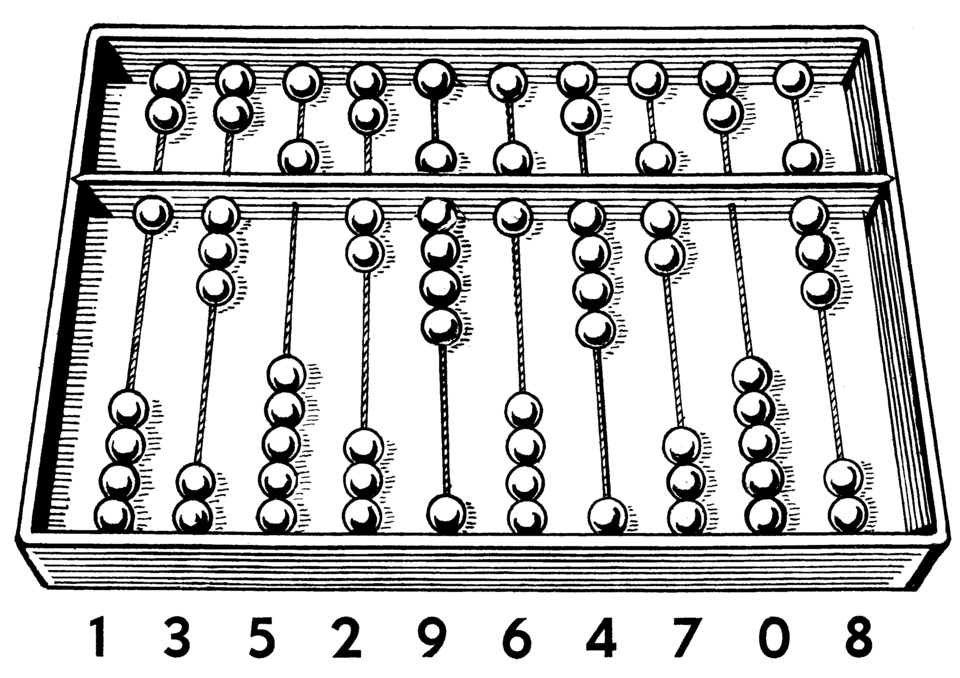
The abacus is a manual counting frame that represents numbers as beads or pebbles arranged in columns, where each column stands for a place value. A person adds, subtracts, multiplies and divides by sliding the counters according to fixed rules. It is the oldest calculating tool in wide use, and it proved that arithmetic could be offloaded from the mind onto a reliable physical device.
What it was
An abacus is a frame holding rods or grooves, with beads or pebbles that move along them. Each rod is a column, and each column represents one place in a number system, usually base ten. The rightmost column holds units, the next holds tens, the next hundreds, and so on. The value of a bead depends entirely on which column it sits in.
The word comes from a root meaning “dust” or “board,” because the earliest counting boards were flat surfaces dusted with sand. A user drew columns and moved pebbles. Counting devices emerged in Sumer between roughly 2700 and 2300 BCE. The Salamis Tablet, a marble counting board from around 300 BCE, is the oldest surviving example. Later cultures built framed bead versions, including the Chinese suanpan and the Japanese soroban.
Think of an abacus as a parking lot for numbers. Each row of spaces means something different, and where you park a car changes how much it is worth. To do arithmetic, you move cars between rows following simple, repeatable rules. The lot remembers the number for you, so your head is free to think about the next step.
Why it mattered
Before the abacus, large calculations lived only in memory or in tedious tallies. Errors crept in, and progress was slow. The abacus gave merchants, tax officials and engineers a stable external memory for numbers. It let a trained user compute faster than most people can with pen and paper, and it did not depend on a written numeral system.
This mattered for trade, taxation and astronomy across the ancient and medieval world. The abacus spread along trade routes from Mesopotamia to Greece, Rome, China and beyond. For centuries it was the standard business machine. Its lasting contribution is conceptual: it showed that calculation is a mechanical process. A number can be a physical state, and arithmetic can be a set of rules applied to that state. That insight underlies every calculating machine that followed.
How it connects to AI today
The abacus introduced two ideas that run straight through to modern AI hardware. The first is place-value encoding: a number is stored as a pattern of states across fixed positions. The second is that arithmetic is a procedure of moving and carrying, not an act of insight. Both ideas are foundational to digital computing.
Trace the lineage forward. Mechanical calculators such as the Pascaline and the Leibniz reckoner automated the carry step that an abacus user performs by hand. Electronic computers such as ENIAC replaced beads with electrical states, but kept the same logic of columns and carries. A modern processor stores numbers as bits in registers, which are place-value columns in base two. The bead is now a transistor that is on or off.
This matters directly for AI. Every neural network is a tower of arithmetic. Training a large language model is billions of multiply-and-add operations, the same add-and-carry the abacus formalised, now run in parallel on GPUs and tensor cores. When a builder writes a matrix multiplication in PyTorch, or watches a GPU report its throughput in operations per second, they meet the abacus idea at industrial scale. The hardware is silicon, but the principle is unchanged: encode numbers as positions, apply rules, carry the overflow, read the result. The abacus is where humans first wrote that principle down in physical form.
Still in use today
The abacus is legacy-accepted. It is no longer a tool of professional calculation, since electronic calculators and computers replaced it for serious work decades ago. Yet it has not been discontinued, and it is still actively made and used in specific niches.
Schools in Japan, China and several other countries teach the soroban and suanpan to build number sense and mental arithmetic. Children who learn the abacus often perform calculations by visualising the beads, a skill called anzan. Competitive abacus arithmetic remains a living tradition. Some markets and small shops still keep one for quick, power-free totalling.
It persists for the same reason it first succeeded: it makes place value tangible. A learner who moves beads sees exactly why a carry happens. No newer tool teaches that intuition as cleanly. The abacus survives not because it is fast, but because it is honest about how numbers work.
Further reading
- IT History Timeline : see the abacus in sequence with the machines it led to.
- AI Learning Galaxy : explore how foundational ideas connect to modern AI tools.
- The Pascaline : the first mechanical calculator to automate the carry operation.
- ENIAC : the early electronic computer that replaced beads with electrical states.
- Abacus (Wikipedia) : broad survey of types, history and use across cultures.
- Salamis Tablet (Wikipedia) : the oldest surviving counting board, dated to about 300 BCE.
- Soroban, Japanese abacus (Encyclopaedia Britannica) : the modern bead-frame abacus still taught today.
Frequently asked questions