ENIAC
The room-sized machine of about 17,468 vacuum tubes that became the first general-purpose, electronic, programmable computer in the US, built to compute artillery firing tables.
ENIAC was a room-sized machine of about 17,468 vacuum tubes, completed in 1945 and unveiled on 14 February 1946. It was the first general-purpose, electronic, programmable computer in the US. Built to compute artillery firing tables, it ran those calculations far faster than any earlier machine.
What it was
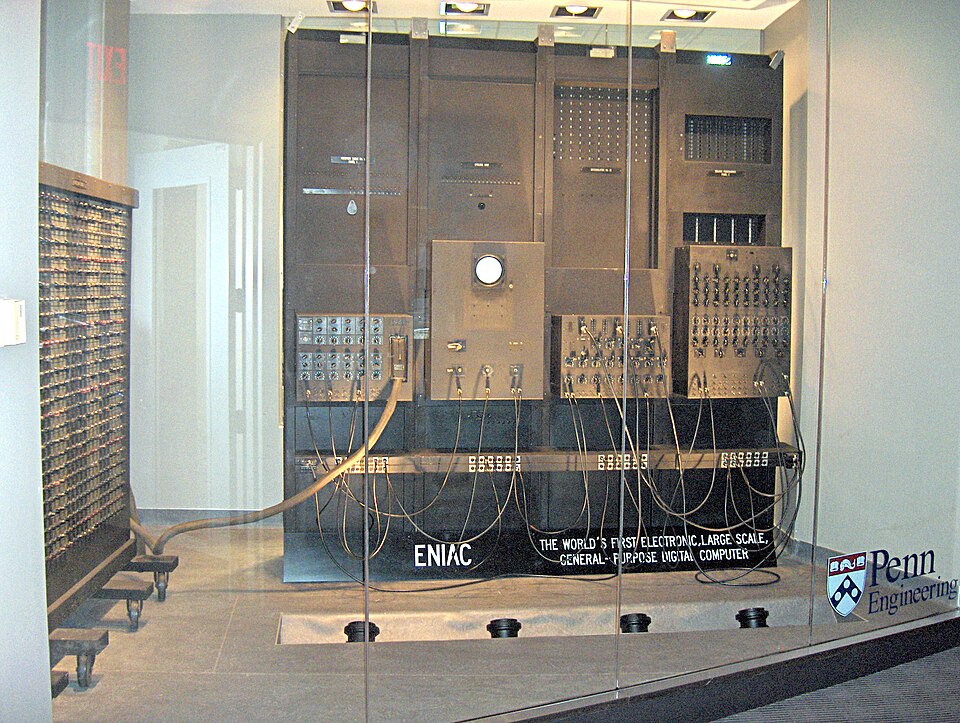
ENIAC stands for Electronic Numerical Integrator and Computer. J. Presper Eckert and John Mauchly built it at the Moore School of Electrical Engineering, University of Pennsylvania. It filled a large room, weighed about 27 tonnes and drew enormous power.
Earlier calculating machines used mechanical gears or electromechanical relays. These parts moved physically, so they were slow. ENIAC replaced them with vacuum tubes, which switch electric current with no moving parts. This made it roughly a thousand times faster than the relay machines of its day.
A useful analogy is the difference between a hand crank and a light switch. A relay machine cranks a physical part to register each step. ENIAC flicks an electronic switch instead, so the work happens at the speed of electricity, not the speed of metal.
Programming ENIAC was not like writing code today. There was no program stored in memory. Operators set up a calculation by plugging cables and setting switches, routing numbers between the machine’s units by hand.
ENIAC worked in decimal, not binary. It held and added numbers using rings of ten counters, closer to a mechanical adding machine than to a modern binary chip. It could add, subtract, multiply, divide and take square roots.
Why it mattered
The US Army funded ENIAC during the Second World War. Gunners needed firing tables, charts that told them how to aim artillery for a given range, wind and shell. Each table took human “computers”, often women with desk calculators, weeks of work to produce.
ENIAC computed a trajectory in seconds that took a person many hours. The war ended before it entered service for its original purpose. Its first major run instead supported calculations for the hydrogen bomb programme.
The machine proved a critical point. Large-scale electronic computing worked and was reliable enough to trust. Vacuum tubes failed often, yet the team kept ENIAC running by finding and replacing weak tubes. This success convinced governments and industry that the electronic computer had a future.
ENIAC also produced a remarkable group of pioneers. The team that programmed it included women such as Kathleen Antonelli, Jean Bartik and Frances Spence, who worked out how to set the machine to solve real problems. Their work was early software, written in cables instead of text.
How it connects to AI today
ENIAC began the electronic computing lineage that runs straight to today’s AI hardware. Its vacuum tubes did the job that transistors do now. A modern chip packs billions of transistors where ENIAC used about 17,468 tubes, but the principle is the same. An electronic switch represents a number and changes it at high speed.
The biggest leap came from ENIAC’s own limitation. Rewiring the machine for each task was slow and painful. John von Neumann, who consulted on the project, helped describe a better design where the program lives in memory alongside the data. This stored-program idea, set out for the follow-on machine EDVAC, defines almost every computer built since. You can trace that thread through the von Neumann architecture that still names the design of your laptop and phone.
For AI, the link is direct. A neural network is a long sequence of arithmetic, mostly multiplications and additions, run at vast scale. ENIAC was built to do exactly that kind of repeated arithmetic faster than people could. A modern GPU is the same ambition pushed to billions of operations per second. The hardware changed; the goal of brute-force numerical computation did not.
A builder meets this lineage often. Every time you train a model, you rely on hardware that descends from ENIAC’s tubes and von Neumann’s stored program. The phrase “computer” itself shifted meaning here, from a person who computes to a machine that does. ENIAC’s commercial successor, UNIVAC , brought that machine into business and government and started the computer industry.
Still in use today
ENIAC is a milestone, not a working product. The original machine was switched off for good in 1955, after nearly a decade of service. No one runs ENIAC for real work now, and its vacuum-tube technology is fully obsolete.
The technology that replaced it is the transistor, invented in 1947, and later the integrated circuit. These are smaller, faster, cheaper and far more reliable than tubes. A single phone chip outperforms ENIAC by an unimaginable margin while drawing a tiny fraction of its power.
What persists is the idea, not the iron. ENIAC proved that general-purpose electronic computing was practical. Sections of the original machine survive on display, including panels at the Smithsonian Institution and the School of Engineering and Applied Science at the University of Pennsylvania. They stand as a monument to the moment electronic computing became real.
Further reading
- IT History Timeline : see where ENIAC sits among the milestones of computing.
- AI Learning Galaxy : explore how early computing connects to modern AI concepts.
- The von Neumann Architecture : the stored-program design that grew out of the ENIAC project.
- UNIVAC : the commercial successor that turned the electronic computer into an industry.
- ENIAC on Wikipedia : full history, specifications and the people who built and programmed it.
- ENIAC at the Computer History Museum : timeline entry and context for the machine’s place in computing history.
Frequently asked questions