UNIVAC I
The first commercially produced electronic digital computer in the United States, built for business and government data processing on vacuum tubes and magnetic tape.
UNIVAC I, the Universal Automatic Computer, was the first electronic digital computer produced commercially in the United States. Designed by J. Presper Eckert and John Mauchly, it was built for business and government data processing rather than pure research. The US Census Bureau accepted the first unit in 1951, marking the moment computers moved from the laboratory into everyday administration.
What it was
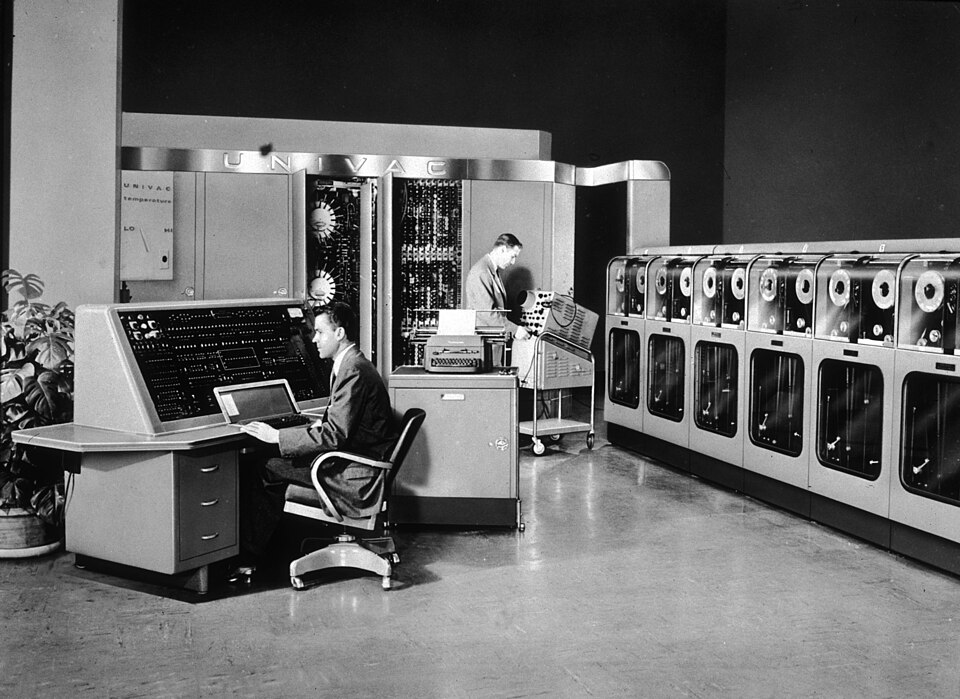
UNIVAC I was a room-sized computer that stored its program and data in electronic memory. It used more than 5,000 vacuum tubes as switches, and it read information from reels of metal magnetic tape instead of punched cards. A separate device called UNITYPER let operators key data onto tape before processing.
Think of it as a vast, automated filing office. Earlier punched-card machines acted like clerks who shuffled cards by hand for every step. UNIVAC I held its instructions in memory and ran them in sequence, so one setup could process millions of records without rewiring. Magnetic tape replaced stacks of cards, much as a single hard drive later replaced filing cabinets.
The machine used mercury delay lines for its main memory. These tubes of liquid mercury stored data as sound pulses that circulated and refreshed. It was slow and delicate by modern standards, yet it was reliable enough to sell as a product.
Why it mattered
UNIVAC I proved that a computer could be a commercial product, not only a university experiment. Eckert and Mauchly had already built ENIAC, but ENIAC was a single research machine. Their new company, later absorbed by Remington Rand, sold UNIVAC I to paying customers across government and industry.
The machine reached the public in 1952, when CBS used a UNIVAC I to predict the US presidential election on live television. With a small sample of returns, it forecast a landslide for Dwight Eisenhower. The result was correct, and the broadcast made “UNIVAC” a household word for the electronic brain.
For organisations, the impact was practical. Insurance firms, the military, and statistical agencies could process records far faster than punched-card equipment allowed. Magnetic tape held data densely and could be read and rewritten, which set the pattern for decades of business computing.
How it connects to AI today
UNIVAC I sits at the root of the data-processing lineage that modern AI depends on. It was one of the earliest practical machines built on the stored-program idea formalised in the von Neumann architecture , where instructions and data share the same memory. Every server that trains a model today still follows that core design.
The deeper link is data at scale. UNIVAC I existed to read large volumes of records, transform them, and write results back. That is exactly what a modern data pipeline does before any model trains. Magnetic tape was the first cheap, high-capacity storage for this work. Tape never disappeared. LTO tape libraries still archive the enormous datasets that cloud providers and research labs keep, because tape is cheaper and more durable than disk for cold storage.
A builder meets this heritage every time they run a batch job. When you load a training dataset from object storage, stream it through a transformation step, and write checkpoints back, you repeat the capture-load-process-output cycle UNIVAC I ran in 1951. The hardware is silicon and the scale is billions of records, but the shape of the work is unchanged. UNIVAC I also normalised the idea of buying compute as a product, which leads directly to renting GPUs by the hour for model training.
Still in use today
UNIVAC I itself is a milestone, not a living product. The last units left service in the 1960s, and the technology that defined it - vacuum tubes, mercury memory, metal tape - is obsolete. Surviving machines and components live in museums such as the Smithsonian and the Computer History Museum.
What replaced it was a fast chain of better hardware. The transistor made vacuum tubes redundant within a decade, and integrated circuits shrank whole cabinets onto chips. The UNIVAC name continued through Remington Rand and Sperry into the 1980s, then faded as the company merged into Unisys.
UNIVAC I persists as an idea rather than a device. The commercial computer market it opened never closed. Magnetic tape, its primary medium, remains in active use for archival storage at scale, which is why this entry counts as a milestone whose influence still runs through every data centre.
Further reading
- IT History Timeline : see where UNIVAC I sits among the machines before and after it.
- AI Learning Galaxy : explore how early computing connects to modern AI topics.
- ENIAC : the research machine Eckert and Mauchly built before UNIVAC I.
- The von Neumann architecture : the stored-program design UNIVAC I helped popularise.
- UNIVAC I on Wikipedia : detailed history, specifications, and customer list.
- Computer History Museum: UNIVAC : primary museum coverage of the first commercial computer makers.
- Smithsonian National Museum of American History: UNIVAC : preserved artefacts and context from the UNIVAC era.
Frequently asked questions