Babbage's Analytical and Difference Engines
The first designs for an automatic calculating machine and a general-purpose programmable computer, conceived by Charles Babbage in 19th-century London.
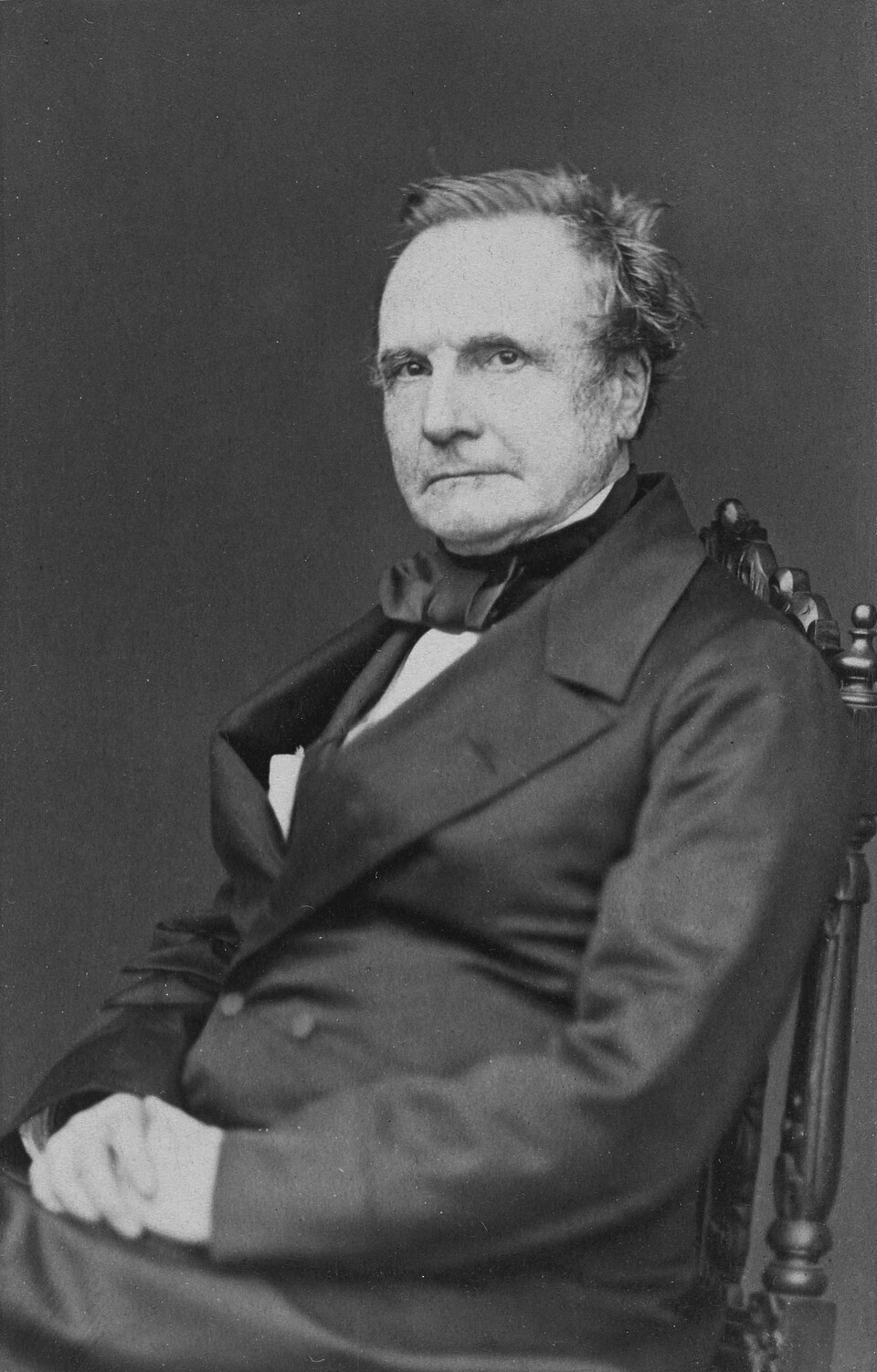
Charles Babbage designed two machines that anticipated the modern computer by more than a century. The Difference Engine, announced in 1822, automated the production of mathematical tables. The Analytical Engine, designed from 1837, was a general-purpose programmable machine with a processor, a memory and punched-card input.
What it was
The Difference Engine was a calculating machine made of brass gears and number wheels. It used a mathematical trick called the method of finite differences. This method turns hard calculations into long chains of simple additions. The machine cranked through those additions automatically and printed the results, which removed the human errors that plagued the hand-computed tables of the time.
The Analytical Engine went much further. Babbage split it into parts that map directly onto a modern computer. The “store” held numbers, like memory or RAM. The “mill” did the arithmetic, like a central processing unit. Punched cards fed in both the program and the data, an idea Babbage borrowed from the Jacquard weaving loom.
A useful analogy is a player piano. A roll of punched paper tells the piano which notes to strike and when. Swap the roll, and you get a different tune from the same machine. The Analytical Engine worked the same way. Swap the cards, and the same brass machine ran a different program.
The Analytical Engine could do conditional branching and looping. It chose between actions based on a result, and it repeated steps. These two ideas sit at the heart of every program written today.
Why it mattered
In the 1820s, navigation, banking and science all depended on printed tables of numbers. People computed these tables by hand, then typesetters copied them. Both stages introduced errors, and a wrong figure in a navigation table could sink a ship. Babbage wanted a machine that calculated and printed without human mistakes.
The British government funded the Difference Engine heavily, then withdrew support after years of cost overruns. Babbage never delivered a complete machine. Yet the design was sound, and the ambition was unmatched.
The Analytical Engine mattered most as an idea. Babbage described a machine that was not tied to one task. Ada Lovelace, who translated and annotated a paper about the engine, saw this clearly. She wrote a detailed method for the machine to compute Bernoulli numbers, often described as one of the first published algorithms intended for a machine. She also grasped that such a machine could manipulate symbols, not only numbers.
How it connects to AI today
The Analytical Engine laid out the blueprint that every computer still follows. Separate the memory from the processor, feed in instructions, and let the machine execute them step by step. Babbage’s “store” and “mill” became the memory and CPU of modern hardware. The punched cards became programs. The conditional and looping logic became control flow.
Punched cards survived for over a century after Babbage. Herman Hollerith used them for the 1890 US census. IBM built a business on card-based machines. Early electronic computers and the first FORTRAN and COBOL programs were loaded from punched cards well into the 1970s. The card was the standard way to feed code and data into a machine.
The deeper link to AI is the concept of general-purpose programmability. A modern neural network runs on a CPU or GPU that descends in principle from Babbage’s mill. The model weights and the input data sit in memory, like Babbage’s store. The training and inference steps loop and branch, exactly the control structures Babbage planned in brass.
A builder meets this lineage every day. When you load a dataset into memory, run a loop over training batches, and branch on a validation metric, you are using the architecture Babbage sketched. Ada Lovelace’s insight, that a machine could process any symbol that follows rules, is the founding premise of software and, by extension, of machine learning.
Still in use today
The original machines are a milestone, not a living product. Babbage’s engines were never mass-produced and have no direct descendants in working order. The technology is best described as a historical landmark that defined the path forward.
The ideas, however, are entirely active. The store-and-mill split lives on as the memory-and-processor model in every device you own. Punched cards are discontinued as a storage medium, replaced by tape, disk, flash and cloud storage. But their logical role, feeding instructions and data to a machine, persists in every program you run.
You can see the physical proof in London. The Science Museum built a working Difference Engine No. 2 from Babbage’s drawings, completing the calculating section in 1991. It runs and prints correctly, which confirms that Babbage’s 19th-century design was mechanically valid. The machine failed in his era for reasons of funding and manufacturing precision, not flawed thinking.
Further reading
- IT History Timeline : see where Babbage’s engines sit among the milestones of computing.
- AI Learning Galaxy : explore how early computing connects to modern AI concepts.
- The Jacquard Loom : the punched-card weaving machine that inspired Babbage’s input system.
- The First Algorithm : Ada Lovelace and the program written for the Analytical Engine.
- Charles Babbage on Wikipedia : biography and full account of both engines.
- The Babbage Engine at the Computer History Museum : detailed history of the Difference Engine No. 2 reconstruction.
- Analytical Engine on Wikipedia : the design, its components and its programmability.
Frequently asked questions