Jacquard loom (punched-card control)
A 1804 loom controlled by punched cards, the first practical machine to read instructions from a stored program, and an ancestor of computing.
The Jacquard loom is a weaving machine guided by a chain of stiff punched cards, where the pattern of holes in each card decides which threads lift for one row of cloth. Joseph-Marie Jacquard demonstrated this control mechanism in France around 1804. It automated the slow, error-prone work of weaving complex figured fabric, and its punched card became one of the most important ideas in the history of computing.
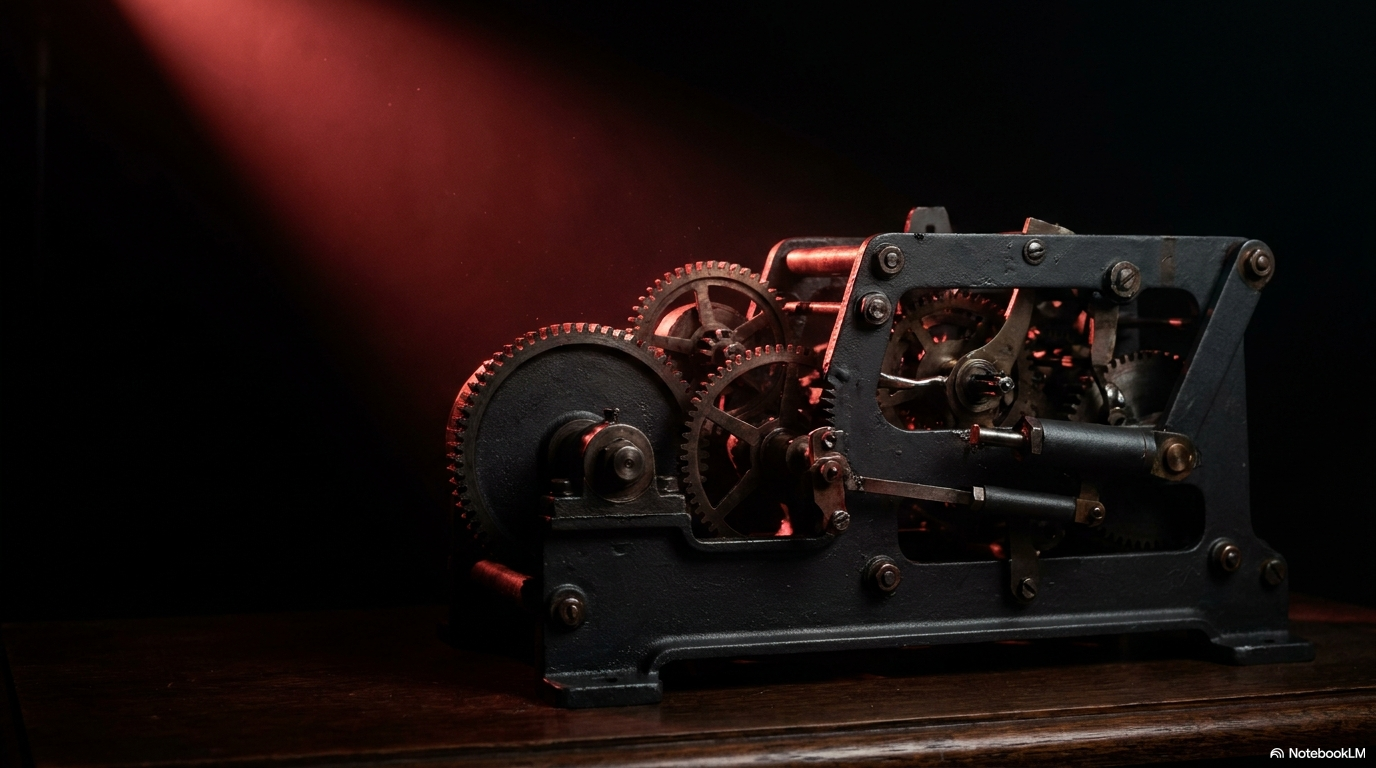
What it was
Weaving figured cloth means lifting some warp threads and leaving others down for every single row. Before Jacquard, a skilled weaver needed a “drawboy” assistant to pull the right threads by hand for each pass. This was slow and full of mistakes.
Jacquard’s mechanism replaced the assistant. A loop of cards passes over a square drum. Each card carries a grid of holes punched for one row. Hooks press against the card. Where a hole exists, a hook passes through and lifts its thread. Where the card is solid, the hook stays down. Advance to the next card, and the next row weaves itself.
Think of it like a player piano. A roll of paper with holes tells the piano which keys to strike and when. The Jacquard card tells the loom which threads to raise. The pattern lives in the holes, not in the operator’s memory.
Why it mattered
The loom let one weaver produce richly patterned silk fast, with consistent results. Patterns that once took weeks could repeat reliably from the same set of cards. The technology spread quickly through the silk centre of Lyon and across Europe.
The deeper significance is the idea behind it. A complex task became a sequence of stored instructions that a machine read and obeyed. Change the cards, and the same loom makes a different cloth. The machine stayed the same. The behaviour changed with the data fed into it.
This is the seed of programmability. Hardware that runs different tasks based on swappable instructions is the foundation of every computer that came after. The loom showed that a physical machine could follow an external, reusable, editable program.
A famous early demonstration was a woven silk portrait of Jacquard himself, produced from many thousands of cards. It looked like an engraving but was entirely cloth. It proved how much detail a card-driven machine could encode.
How it connects to AI today
The punched card is the direct bridge. Charles Babbage studied the loom and planned to control his Analytical Engine with punched cards, separating the program from the machine. Ada Lovelace, who wrote what many consider the first algorithm for that engine, captured the link precisely: the engine “weaves algebraic patterns just as the Jacquard loom weaves flowers and leaves.” See the Analytical Engine for that lineage.
The card then escaped the textile world entirely. Herman Hollerith used punched cards to tabulate the 1890 United States census, founding a company that became IBM. For most of the twentieth century, punched cards fed payroll systems, scientific calculations, and the first electronic computers. Programmers literally carried decks of cards to the machine room.
The pattern still defines how AI runs today. A modern neural network is fixed hardware and weights driven by data. You feed different inputs, prompts, or training sets, and the same system produces different outputs. That is the Jacquard principle at planetary scale. The instructions live in the data, not the device.
A builder meets this idea every day. Configuration files, model checkpoints, and prompt templates are the modern cards. Even the word “weaving” survives in machine learning, where models combine learned features into structured output. The loom proved that behaviour could be encoded, stored, and swapped. Every program you write is a descendant of that single insight.
Still in use today
The original card-driven looms are legacy-accepted. Antique and reconstructed Jacquard looms survive in textile museums and a few specialist workshops, prized for heritage and demonstration. They run, but they are not the production standard.
The weaving method itself is very much alive. Electronic Jacquard machines still lift individual warp threads to create intricate patterns. They power the production of damask, brocade, upholstery, and figured fabric worldwide. What changed is the control layer. Physical cards gave way to digital pattern files and electromagnetic or piezoelectric actuators that lift each thread.
So the punched card as a physical object is obsolete, retired across computing and textiles alike. The concept it carried, a stored program that directs a machine, became universal. The loom did not survive by staying the same. It survived because the idea inside it outgrew the wood and steel that first held it.
Further reading
- IT History Timeline : where the Jacquard loom sits in the broader story of computing.
- AI Learning Galaxy : explore how programmability connects to modern AI concepts.
- Punched cards : how Jacquard’s idea became the dominant data medium for decades.
- The Analytical Engine : Babbage’s card-controlled machine that borrowed the loom’s principle.
- Jacquard machine (Wikipedia) : detailed history of the mechanism and its inventor.
- Computer History Museum: Babbage Engine : the lineage from card-driven looms to programmable engines.
Frequently asked questions