Juggling and Technology
The cascade as a distributed system. Props as AI agent types. Dropping a ball as incident response. If you juggle, you already understand cloud architecture and AI.
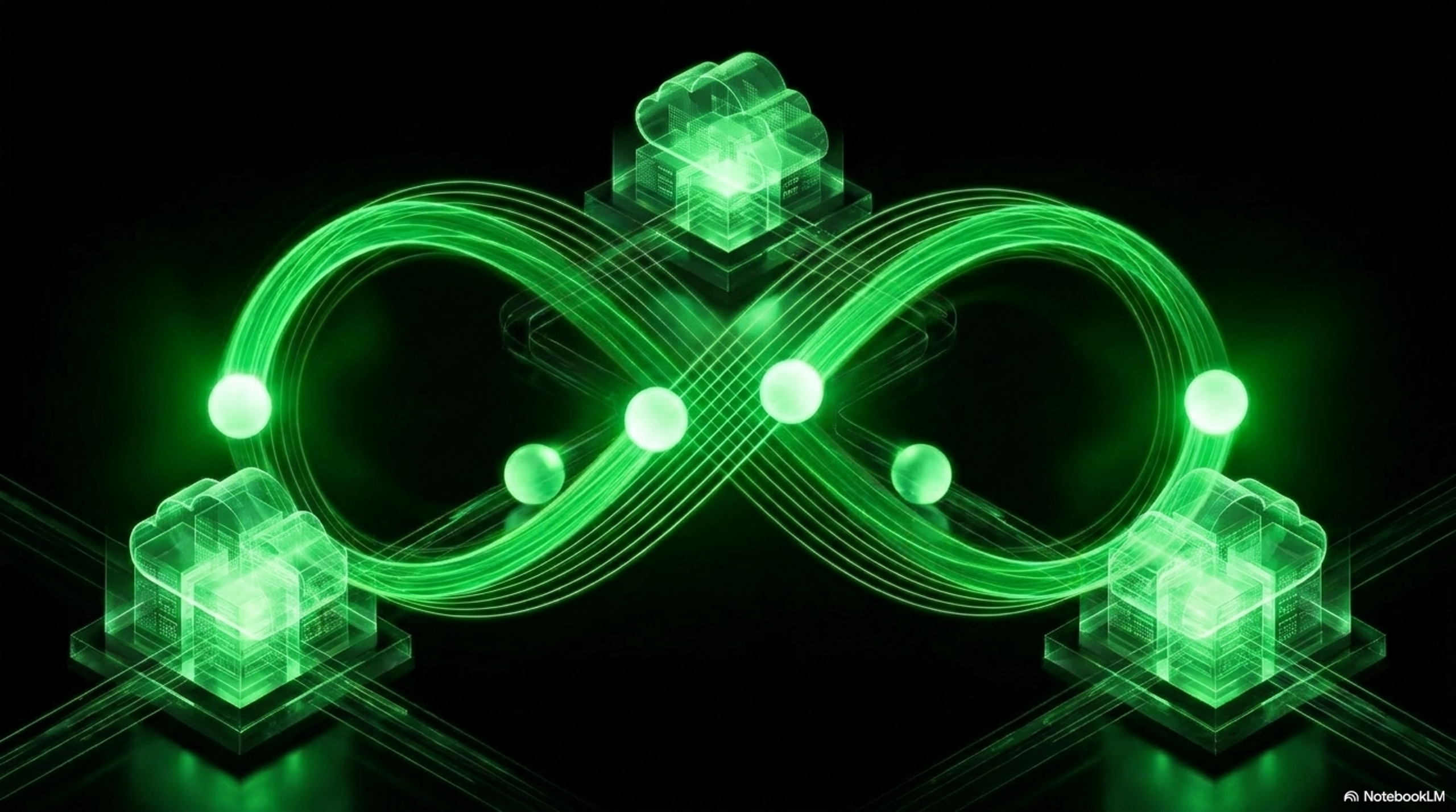
Most of the time spent at AWS re:Invent ends up with someone asking why the stage is closer to a circus than a keynote. The honest answer: they are the same stage.
A juggler holds a small system together at the edge of capacity. A platform engineer does the same thing on a slower clock with bigger props. The vocabulary is different. The control loop is not.
The cascade is a control loop
A juggling cascade is a control loop disguised as a trick. Eyes track, brain predicts, hands execute, the next throw corrects the last drop. The loop does not pause for novelty. When you add a new prop or change the rhythm, you negotiate the change while the loop keeps spinning.
Every cloud system worth shipping is the same shape. Health checks predict. Auto-scaling executes. Deploys correct. Rollbacks recover. The clock is slower. If the loop ever stops, the system stops.
The structural equivalences:
| Juggling | Cloud and AI |
|---|---|
| Three-ball cascade: alternating throws on a fixed beat | Round-robin load balancing: even distribution across healthy targets |
| The apex: the moment between throw and catch where you can plan | The deploy window: the gap between traffic spikes where you can ship |
| Adding a fourth ball collapses the cascade into a fountain | Adding a region collapses your single-cluster model into multi-master |
| A drop costs you one beat, if you do not panic and chase it | A failed pod costs you one window, if you let the orchestrator do its job |
| Different-weight props: same pattern, different hand-feel | Different runtimes (Lambda, ECS, EKS): same shape, different tuning |
| Pass to a partner: you trust their timing or you both drop | Cross-team contracts: you trust the SLA or the integration breaks |
Go deeper: Reliability Pillar and Message Queue
The pattern is stable because the timing structure is self-cuing. Each output produces the conditions for the next input.
No external scheduler. The physical constraint that hands cannot hold more than one ball at a time enforces the protocol. Well-designed message queues work the same way.
The timing window and why systems break
A common mistake when modelling the cascade: assuming the timing is rigid. It is not. The flight arc of each ball gives a small but real window for the catch. A throw that arrives slightly late shifts the next catch slightly late. The pattern breathes.
This elasticity is what makes the cascade robust to small perturbations. As long as no single error exceeds the available window, the pattern recovers without intervention.
The same property makes well-designed message queues robust. A queue that admits a small amount of latency variance absorbs jitter without dropping messages. A queue with zero tolerance for variance fails the moment either side runs slightly slow.
When the cascade scales from three to five balls, the timing tolerance does not scale linearly. To accommodate two more balls, throws must go roughly three times higher. But the catch window per ball does not grow proportionally. The system is more sensitive to jitter at five balls than at three, even though the pattern is structurally identical.
This is the same shape as the throughput-latency curve of distributed systems. Adding capacity often does not buy you the headroom it appears to.
Go deeper: Capacity Planning for AI and Stream Processing
Props as AI agent types
Every juggling prop teaches a different lesson about complexity. They map directly onto AI agent types.
The teams shipping the best agentic systems are not the ones with the deepest theory. They are the ones who have shipped enough cloud to know what the control loop feels like. They have the muscle to add a ball without dropping the rest.
Go deeper: Building RAG Systems and LLMOps
Each node in the network is a prop in the air. The connections are the handoffs. The pattern is the system.
Choose the prop before you choose the model. A ball running on a club-class model wastes budget. A club thrown with ball-level precision drops every time.
When the pattern changes shape
The four-ball fountain is structurally different from the cascade. In the fountain, each hand operates independently. There is no shared buffer. Two workers run parallel processes with no cross-traffic.
This makes the fountain easier in one sense (no cross-coordination required) and harder in another (no shared buffer means no error correction across hands). A stable hand cannot help an unstable one.
This is the same architecture choice as coupled vs decoupled distributed systems:
- Coupled (cascade): shared state, self-correcting, but failures cascade
- Decoupled (fountain): isolated failure, no mutual aid, runs independently
Neither is universally better. The right choice depends on what you optimise for. Knowing which pattern you are running is the first step to debugging it.
Go deeper: Feature Branching and Concept Drift
Further reading
- Juggling and the Brain : how pattern recognition and attention work, and what that means for learning systems
- Juggling and Change : drop recovery, incident response, and managing teams through transformation
- Juggling and Technology : the full technical deep-dive at The Juggling Company
- Reliability Pillar : the fault tolerance framework for production systems
- Capacity Planning for AI : knowing when and how to scale
- LLMOps : operating AI systems in production
- The Craft of Software : analogue workshop metaphors for the same core concepts